
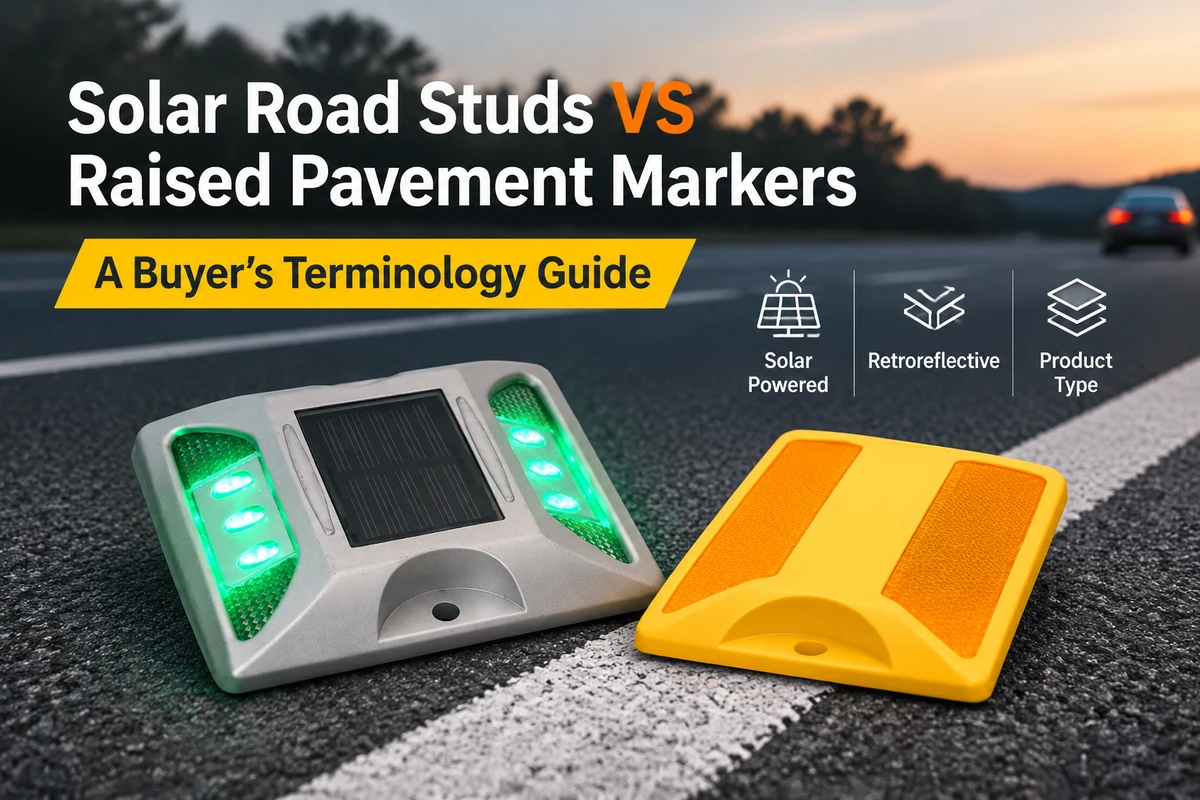
An RFQ for “two-way road studs” can produce quotations for very different products: a passive retroreflective marker, a solar LED stud, or an illuminated unit with additional reflective faces. The descriptions may sound compatible while the quoted configurations are not.
Solar road studs and raised pavement markers are not necessarily mutually exclusive categories. “Solar” identifies a power source; “raised pavement marker” describes a pavement-marking category whose precise requirements depend on the specification. Neither name establishes the complete optical, mounting, or approval requirements.
For importers, distributors, and project procurement teams comparing solar road studs vs raised pavement markers, the practical task is to translate those names into specifications that suppliers can quote consistently.
Define the Required Marker Type Before Issuing Your RFQ
Before requesting prices, decide whether the project requires passive retroreflection, active illumination, or both. A passive retroreflective marker returns incident light toward its source, such as a vehicle's headlights. An active stud emits light from an internal light source. Active products may use solar or wired power, and some also incorporate retroreflectors.
These distinctions matter because power source and optical function are separate purchasing decisions. Specifying solar power does not establish whether reflective faces are required. Specifying an active stud does not establish whether the supplier should quote a self-contained solar product or a wired system.
Use the following table to identify what an enquiry still needs to say. These are procurement interpretations, not universal regulatory definitions.
| Term in an enquiry | What it identifies or suggests | What still needs confirmation |
|---|---|---|
| Raised pavement marker / RPM | A pavement-marking product category | Optical function, installed profile, mounting and governing specification |
| Retroreflective pavement marker | A requirement for retroreflection | Reflective directions, colours, optical performance and physical configuration |
| Solar road stud | Solar-powered operation, commonly with LED illumination | Storage configuration, operating mode, runtime conditions, reflective features and mounting |
| Active road stud | A product with its own light source | Power source, control method, optical directions and operating mode |
| Cat’s eye / road stud | A name used for road-marking devices | The actual product type, model and complete specification |
If a supplier offers a different configuration, ask for it as a separately identified alternative. This keeps an unsolicited option from being mistaken for a compliant quotation.
Match Supplier Terminology to the Project Specification
The supplier's catalogue name should connect clearly to the item your customer or project requires. A familiar label alone is insufficient.
For example, Britain's Highway Code uses “reflective road studs,” while ASTM D4280-23 uses the more specific description “nonplowable, retroreflective raised pavement markers” in its scope. These examples show why procurement teams should preserve the applicable technical description rather than assume that every familiar term is interchangeable.
Cross-Reference Names with Project Documents
For project purchases, link the supplier's model to the relevant bill of quantities (BOQ) item, drawing reference and specification revision. For distributor stock purchases, link it to the agreed catalogue specification and intended applications instead.
Where the documents conflict, request clarification from the designated technical approver before accepting the product. The priority between a BOQ, drawing and specification should follow the project's contractual arrangements; a supplier's interpretation does not settle that conflict.
Keep the original project description alongside the clarified product configuration. This gives purchasing, engineering and sales teams a common reference when a local customer and an overseas factory use different names for the same requested item.
Specify Optical Faces, Colours, and Operating Modes Separately
“Two-way” needs a defined object. Does it describe retroreflection toward two directions of traffic, LED output toward two directions, or both? A product photograph or LED count cannot answer that reliably.
Ask for a drawing or annotated photograph showing each optical face and its orientation relative to traffic. If an illuminated stud also has retroreflectors, record both arrangements separately.
Distinguish the Colours Being Quoted
A colour description can refer to the housing, the reflected light, or the emitted LED light. “Yellow stud” therefore leaves room for disagreement about what will arrive.
State the required body colour and optical colours separately, including any difference between opposing faces. Then identify the operating mode: steady, flashing, or another specified control arrangement. Where timing or synchronisation matters, ask the supplier to explain the proposed control method.
The intended use must also permit the selected colours and operating behaviour. Britain's Traffic Signs Regulations and General Directions explicitly distinguish reflected and emitted light, and specify steady illumination in certain road-marking provisions. That is a jurisdiction-specific example, not a global rule for every installation.
For procurement, the lesson is straightforward: a supplier's available colour or flashing option is not evidence that the configuration is suitable for the destination project.
Confirm Mounting Details Before Comparing Product Dimensions
Two products with similar overall dimensions may require different installation work. Terms such as “surface-mounted,” “embedded” and “flush” should lead to a sectional drawing, not end the technical discussion.
Ask the supplier to distinguish overall product height from the installed projection above the road. The drawing should also identify any embedded body, stem, housing or fixing arrangement. An embedded component does not, by itself, prove that the finished installation is flush.
This distinction is particularly important when replacing an existing marker or supplying a contractor working to an approved installation detail. Similar-looking studs are not necessarily interchangeable with the same recess, base or fixing method.
Clarify the Installation Supply
Confirm whether the quotation covers the marker alone or also includes a mounting shoe, fixing components, adhesive or other installation materials. Request the manufacturer's installation instructions and any compatibility requirements for the specified pavement and bonding system.
Do not let a generic installation guide override the instructions for the quoted model. The purchase documentation should make clear which components the supplier provides and which the installer must source locally. This prevents an apparently complete unit price from concealing additional materials or a different installation method.
Turn Solar Performance Claims into Verifiable RFQ Requirements
Descriptions such as “long life,” “heavy duty” and “extended autonomy” are starting points for questions. They are not sufficient acceptance criteria.
For a solar LED stud, request the proposed solar panel and energy-storage configuration, operating mode, and supporting performance evidence. If a supplier offers battery or storage alternatives under one model family, identify exactly which option the price includes.
Ask What the Runtime Claim Assumes
A runtime statement should identify the charging procedure, initial charge condition, temperature, LED operating mode and criterion used to determine the end of the test. Continuous operating hours and a number of nights are not directly comparable without the operating schedule.
Provide relevant site information, including shading and seasonal operating requirements, so the supplier can explain the basis of its proposal. A demonstration after a full charge does not establish performance under every installation condition.
For “waterproof” or load-resistance claims, request the test method, tested configuration, conditions and result. A headline force rating without its loading arrangement should not become an assumed vehicle-use rating.
The buyer and technical team should set the required performance from the project conditions, then assess evidence against it. Do not select a requirement simply because it is the largest figure in competing brochures. Passive markers do not need solar or battery fields, but their optical, mechanical and installation requirements still need confirmation.
Verify That Test Reports and Approvals Cover the Quoted Model
A document can be genuine and still fail to establish that the proposed product meets your requirement. Start with its scope, then check the connection to the quoted configuration.
ASTM International's published scope for D4280-23 covers nonplowable, retroreflective raised pavement markers for nighttime lane marking and delineation. A reference to that standard does not, by itself, establish solar charging performance, battery autonomy or permission to use an illuminated product on a particular road.
Likewise, Britain's Traffic Signs Regulations and General Directions distinguish studs incorporating a light source from those with reflectors or retroreflecting material only. The provisions include approval requirements for illuminated types. Buyers should not apply that national process globally or assume that a product test report fulfils it.
Use a document review that asks what each piece of evidence actually establishes:
| Evidence check | What to match | What remains unresolved if the match is missing |
|---|---|---|
| Product identity | Report model, drawing, configuration and quoted variant | Whether the report applies to the supplied item |
| Technical scope | Standard edition, test method and assessed properties | Whether the requested property was evaluated |
| Test conditions | Specimen arrangement, settings and stated limits | Whether the result supports the proposed use |
| Road-use approval, where required | Approval document, covered type, jurisdiction and conditions | Whether the intended deployment is permitted |
Request clarification for incomplete matches rather than treating all certificates as equivalent. Keep an unresolved requirement visible in the comparison until the responsible technical party accepts the evidence or the supplier changes its proposal.
Use Separate RFQ Line Items for Passive Markers and Solar LED Studs
An enquiry such as “Please quote solar reflective cat eyes, two-way” combines terms without establishing whether the buyer needs LEDs, retroreflectors, or both. It also leaves mounting, colours and working conditions open.
The following illustrative RFQ descriptions address two different purchasing requirements. They are not interchangeable specifications. Replace the bracketed fields with approved project information before use.
Example A: A Passive Retroreflective Marker RFQ
Please quote [quantity] passive retroreflective pavement markers for [project/application and destination market], against [specification and drawing references, including revisions]. No active light source is required.
Required reflective arrangement: [directions and colour of each face]. Required body and mounting configuration: [material, dimensions, installed projection and fixing details].
Identify the proposed model and supply the drawing, relevant optical and mechanical test evidence, installation instructions, and any approval documents required by the project.
List included accessories, packing quantity, MOQ, sample and production lead times, quotation currency, delivery basis and warranty terms. State every deviation separately.
Example B: A Solar LED Road Stud RFQ
Please quote [quantity] solar-powered LED road studs for [project/application and destination market], against [specification and drawing references, including revisions].
Required LED arrangement: [directions and colour of each face]. Operating mode: [approved mode]. Passive retroreflectors: [required configuration or not required]. Mounting: [drawing reference and installed profile].
Identify the model and quoted energy-storage option. Provide charging and runtime evidence under [agreed conditions], relevant optical, sealing and mechanical test evidence, installation instructions, and required road-use approval documents.
List included accessories, packing quantity, MOQ, sample and production lead times, quotation currency, delivery basis and warranty terms. State every deviation separately.
Attach a response column for each requirement: “complies,” “deviation,” or “clarification required.” Ask suppliers to identify alternatives on separate quotation lines, with their differences explained. This makes the comparison usable even when catalogue terminology varies.
Compare Supplier Quotes on Equivalent Configurations and Supply Terms
A price comparison becomes meaningful once the underlying product configurations are aligned. A lower unit price may cover a different reflective arrangement, storage option, mounting assembly or documentation package.
Prepare one comparison row for each complete quoted variant. Record the model, drawing revision, optical arrangement, power configuration and included installation components together. Do not group several technically different options under one “solar road stud” price.
Check the Commercial Basis Behind the Unit Price
Align quotation currency, order quantity, packing unit, delivery basis and destination. Confirm whether the MOQ applies to the total order or to each colour, mode or model variant, and whether mixed configurations change pricing or lead time.
Separate sample availability from production lead time. Ask when the stated production period begins and whether model approval, packaging confirmation or other agreed steps must be completed first.
Review warranty scope against the actual configuration. For solar products, clarify how the terms address the energy-storage component and other parts, what evidence is needed for a claim, and which replacement or transport costs each party bears.
A comparison should show technical deviations and commercial exclusions alongside price. This allows the purchasing team to decide whether an alternative is acceptable, requires engineering review, or is simply a different product. It avoids rewarding an incomplete quotation for appearing cheaper.
Align the Approved Sample, Purchase Order, and Bulk Acceptance Criteria
Sample approval should identify what was approved. Record the supplier's model, configuration, drawing revision and the observed features of the sample, then carry those references into the purchase order.
For an illuminated product, that record should distinguish LED directions and colours, reflective features, operating mode, energy-storage option and mounting structure. A sample that lights up does not, on its own, verify every runtime, mechanical or environmental requirement.
Control Configuration Changes and Agree on Acceptance
Ask the supplier to identify proposed substitutions before production and obtain written acceptance where required. A change to storage, optical components, housing or control settings should prompt a review of whether the agreed evidence and performance commitments still apply.
Agree on inspection methods, acceptance criteria, required records and replacement arrangements before placing the order. Separate checks that can reasonably be performed during receiving inspection from performance verification requiring specific test conditions or facilities.
For repeat purchases, reference the approved specification and revision rather than relying solely on “same as last order.” Preserve the link between the ordered configuration, delivered batch and supporting documents.
Before requesting your next quotation, send each shortlisted supplier the same completed specification sheet and require a response against every field. Clear terminology then becomes a practical purchasing tool: it helps your team compare equivalent proposals and keeps the agreed product consistent from enquiry through delivery.
Source references
This supplied NOKIN procurement guide discusses the scopes of ASTM D4280-23, the UK Highway Code, and the Traffic Signs Regulations and General Directions 2016. Check the current applicable text and project requirements.